
Victors Home Tutors
A tuition bureau matching parents with tutors across Varanasi — where the hard part was not the website, but verifying the adult you are sending into a child's home.
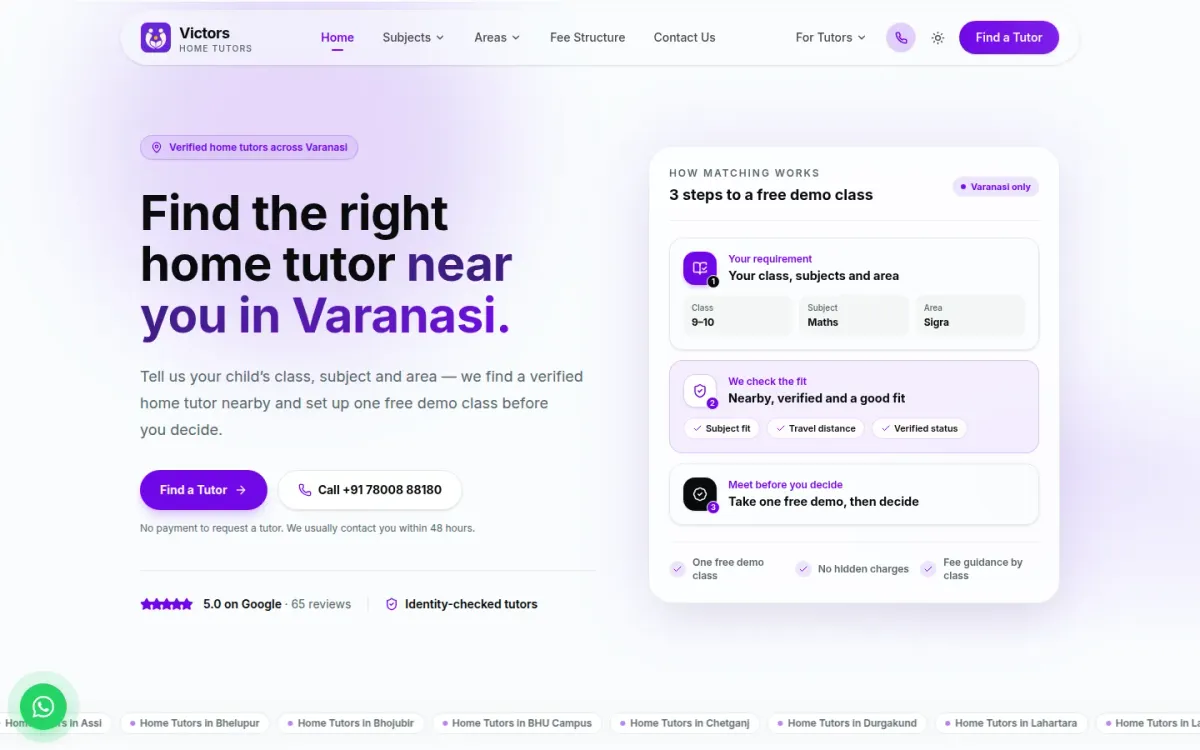
Victors Home Tutors matches parents in Varanasi with tutors who come to the house. Both sides had to be online. One of them involves sending an adult into a child’s home.
That single fact decided the whole build. Verification could not be a feature added later once the platform had users, because the first unverified tutor is the one that matters.
The obvious solution was not legally available
The instinct is to check a tutor’s Aadhaar and be done with it.
A private business in India cannot. The Supreme Court struck down Section 57 of the Aadhaar Act in 2018, and with it the route that let private entities run Aadhaar authentication. There is no compliant “just verify their ID against the government database” path here, whatever a vendor’s sales page implies.
We say this plainly because it is the first thing a competitor quoting this project will get wrong.
So a person reviews every application
Any government ID is accepted, and a member of staff actually looks at it alongside a photograph of the applicant. Nobody sees a single job until that review passes.
Applications are also checked against previous ones, so somebody rejected once cannot quietly reapply under a new name. That last part is what makes the difference between a verification badge and a verification process.
Handling ID photos without breaching the DPDP Act
An identity document and a photograph of a face are personal data, and the Digital Personal Data Protection Act, 2023 attaches real duties to holding them: collect only for a stated purpose, keep them only as long as that purpose lasts, and be reachable when somebody asks what you hold.
That shaped what is collected, where it is kept, how long it stays and who can open it. Records are retained deliberately, with a route to report an incident and cooperation language in the terms — because verification deters somebody trying it twice, it does not stand in for what has to happen if an actual crime occurs.
Phone confirmation over WhatsApp, not SMS
Parents and tutors confirm their number over WhatsApp. It is where they already read messages.
It also removed the TRAI DLT registration that a bulk SMS route would have obliged the client to complete before sending a single message — a piece of paperwork that would have delayed launch by weeks and cost money every month afterwards.
Getting long applications finished
The tutor form asks for qualifications, subjects, classes, areas, experience and a photograph taken on the spot. That is too much for one screen on a phone, and the camera step is exactly where people put the phone down.
It runs as a few short steps instead, and progress is kept — close the tab, come back, carry on. Fewer half-finished applications is the whole point.
Matching by actual distance
A parent drops a pin on Google Maps rather than typing an address, and a request only reaches verified tutors within a few kilometres.
A tutor in Lanka is not alerted to a lead across the river, so the alerts stay worth reading. An alert nobody trusts gets ignored, and then the platform is just a list.
What runs it
Laravel and PostgreSQL behind the site, with a private admin area where staff approve tutors and see where tutors and requests actually are on a map. An Android app shares the same system, so nobody maintains two sets of numbers.
We deploy it, keep it patched and backed up, and pick up the phone when something needs changing. The client did not receive a folder of files and a handshake.
Why this is here
Most agency portfolios show a homepage screenshot. The work in this project is almost entirely invisible in one: a legal constraint that removed the obvious answer, a data-protection duty that shaped the database, and a matching rule that decides whether alerts get read.
If your business has a problem shaped like that, see custom software development in Varanasi, or what we charge.