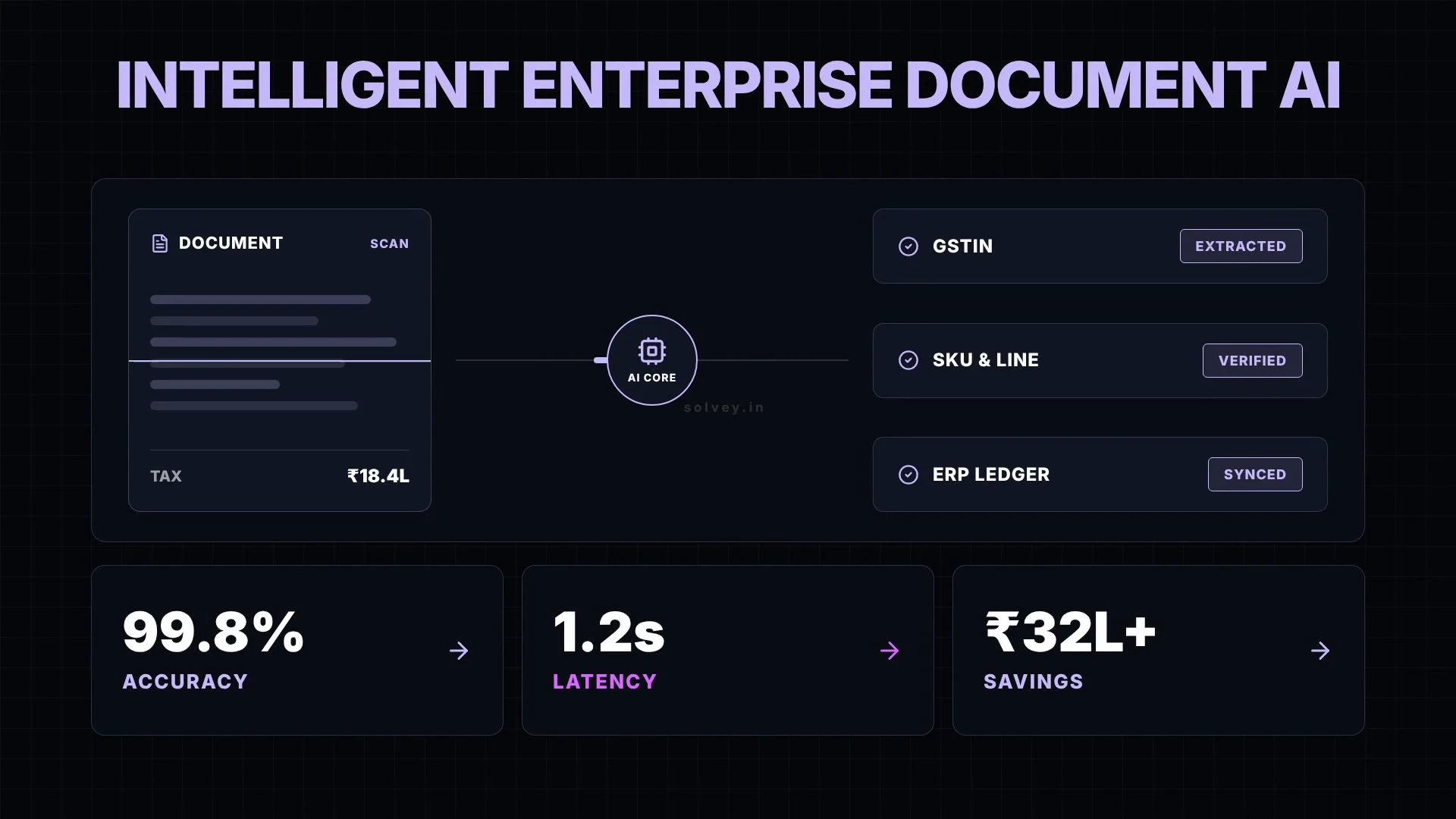
AI automation for the work your team repeats all day and nobody enjoys — retrieval over your own documents, search that understands the question, reading and extraction at volume, and multi-step pipelines that run the whole job rather than one call. Built into your own systems, with a person on anything it is unsure about, and an honest answer first about whether your case needs it at all.
RETRIEVAL (RAG) SEMANTIC & VECTOR SEARCH DOCUMENT UNDERSTANDING ORCHESTRATION MULTI-AGENT PIPELINES STRUCTURED EXTRACTION CLASSIFY & ROUTE EVALUATION & GUARDRAILS HUMAN IN THE LOOP SYSTEM INTEGRATION ENTERPRISE SCALE DPDP-AWARE BY DESIGN
RETRIEVAL (RAG) SEMANTIC & VECTOR SEARCH DOCUMENT UNDERSTANDING ORCHESTRATION MULTI-AGENT PIPELINES STRUCTURED EXTRACTION CLASSIFY & ROUTE EVALUATION & GUARDRAILS HUMAN IN THE LOOP SYSTEM INTEGRATION ENTERPRISE SCALE DPDP-AWARE BY DESIGN
RETRIEVAL (RAG) SEMANTIC & VECTOR SEARCH DOCUMENT UNDERSTANDING ORCHESTRATION MULTI-AGENT PIPELINES STRUCTURED EXTRACTION CLASSIFY & ROUTE EVALUATION & GUARDRAILS HUMAN IN THE LOOP SYSTEM INTEGRATION ENTERPRISE SCALE DPDP-AWARE BY DESIGN
What these systems do
The work is reading, deciding and checking.
Not a chatbot on the front of a website. Documents read and the fields pulled out for a person to confirm; enquiries classified and routed with their history attached; questions answered from your own records, with the source shown. It runs inside your systems and under your access rules, at whatever size the department needs — and anything it is unsure about goes to a person.
Plan your AI project
Will it pay for itself?
Describe the job you have in mind and see whether it is worth automating, and where a person still needs to sit in the loop. It takes about ten seconds and it is the same test we run before quoting.
Change any of the three and the answer moves. It is the same test we run on the first call, so you can have it now instead of waiting for a meeting.
A map of how often a task happens against whether it needs judgement. Your answers place it in the This is what AI is for square.
A personAI pays hereLeave itA rule
Judgement → RulesRare → Constant
Worth building
This is what AI is for
Judgement, happening constantly, where a mistake gets caught and fixed. It handles the ordinary volume on its own, says when it is unsure instead of guessing, and sends only the odd ones to your team. This is where the hours come back.
What you get
Software that reads, checks and answers.
01 AI in your workflow
Get the reading and the sorting done before anyone sits down
The work that pays is rarely the chat window. It is the pile of documents read overnight, the enquiries already sorted when your team arrives, and the uncertain ones waiting in one short list instead of buried in the rest.
Retrieval first, then the answer — the question finds the right passages in your own files, and only those are used to write the reply, with the source shown
Reading uploaded documents, pulling the fields out as structured data, flagging what a person must still check
Pipelines rather than single calls — six steps chained, each result kept, failures retried, a stopped run resumed where it stopped
Scored on a set of real questions with known answers, every time it changes, so a release that made it worse is caught here rather than by your customers
We build AI into your product. We do not use it to produce your project cheaply and hand you the output
Live on this page — the chat is ours
tutor-verification
Reading document…
The moving parts
What an AI system is made of.
“AI” is not one thing you buy. It is a retrieval step, a store to search, a pipeline to run the work, and a way to measure whether it is still right. Here is what each part does and why your project would need it.
Loading Modular Stack...
The model provider and the vector database are named in your proposal rather than on this page — both are deliberately replaceable, because model pricing and quality move every few months and the retrieval, the pipeline and the test set are the parts that have to survive that. The rest of what we build with is on custom software development.
What's included
What we actually build.
01
Answers out of your own documents
The question is used to find the right passages in your files first, and the answer is written only from those — with the source shown, so anyone can check it. This is what retrieval-augmented generation means in practice, and it is the difference between a system that quotes your policy and one that invents a plausible version of it.
02
Search that understands the question
Staff and customers asking in their own words and getting the right document or product, because the search matches meaning rather than spelling. Someone typing 'won't switch on' finds the power-supply note, and a synonym stops being a dead end.
03
Reading documents
Invoices, forms, certificates and IDs read at volume, the fields pulled out as structured data your other systems can use, and anything unclear handed to a person instead of guessed.
04
Multi-step work, run end to end
Jobs that take six steps rather than one — read, look up, decide, write, file, notify. Each step's result is kept, failures retry on their own, and a run that stops halfway resumes where it stopped instead of starting again.
05
Several agents on one job
Work split across specialised steps that check each other — one drafts, one verifies it against the source, one decides whether it is good enough to send or belongs with a person. Slower than a single call and considerably harder to fool.
06
Sorting what comes in
Enquiries, complaints and applications classified and routed the moment they arrive, so nobody spends the first hour of the day triaging.
07
Summarising the pile
Calls, tickets, reviews and long threads turned into the version a manager can act on, with the original one click away.
08
Scored against a test set
A set of real questions with known right answers, run against the system on every change, so you find out a release made it worse before your customers do. Most AI projects have no such thing, which is why they degrade quietly.
09
Wired into what you already run
It reads from and writes to your existing systems over their APIs and webhooks — your CRM, your accounts, your spreadsheets, WhatsApp on the official Meta API — so the output lands where the work already happens rather than in another dashboard nobody opens.
10
An assistant on your own information
Answers from your prices, stock, timings and rules — and says it does not know rather than inventing something that sounds right. The most visible of these, and rarely the one that pays best.
11
Checks before a human looks
The obvious problems caught first — a missing field, a mismatch, a duplicate — so the person reviewing sees a shortlist, not a queue.
12
Drafting, never sending
A reply, a quote or a note prepared and waiting for somebody to approve it. Nothing reaches your customer unread.
13
Enterprise Systems
The same work at organisation scale — your own data, your own rules, access controlled per team, and an audit trail of what was decided and why.
14
Telling you when it is wrong
Confidence surfaced, uncertain cases flagged, and a log you can go back through. A system that cannot admit doubt cannot be supervised.
NamedAI work you can check, not claims
TestableOne of them is live on this page
AlwaysA person on the uncertain cases
Platforms & tools
How it finds an answer, and where it runs.
These are the moving parts of an AI system, in the words the market uses for them. Which model or which vector database sits underneath is our problem to solve and a decision that should survive being changed — what matters to you is that it answers from your information, inside your system, under your access rules.
How it finds the answer
Retrieval over your files
Semantic search
Sources cited
Structured extraction
How the work is run
Multi-step pipelines
Specialised agents
Retries and resume
Scored test set
Where it runs
Inside your system
Behind your login
Access per team
Audit trail
What it connects to
Official WhatsApp API
Email
REST APIs
Webhooks
Great for
Teams whose morning starts with somebody sorting yesterday's enquiries by hand
Anyone checking the same kind of document dozens of times a week
Businesses answering the same twenty questions on WhatsApp all day
Organisations with years of documents nobody can find anything in
Anyone who has been quoted for AI and could not get a straight answer about what it would actually do
How we approach it
How an AI project runs.
01
Find the one task
We look for work that is judgement, happens constantly, and can be checked afterwards. If your case is a rule or a rarity, we say so and there is no project.
02
Test it on your real backlog
Before you commit, on your own documents or messages, so you see where it is right and where it is not. A demo on invented data proves nothing.
03
Build it with the person in it
The uncertain cases route to somebody. We agree the threshold with you, in writing, rather than picking one and hoping.
04
Watch it, and keep watching it
What it got wrong, how often, and what changed. This is the part most AI projects skip and the reason most of them quietly stop being used.
Before you commit
See it work on your own data first.
Every AI demo works. They are built to. The only test that tells you anything is what happens on your real documents, your real enquiries and your real backlog, including the messy ones — so that is what we do before you sign anything.
Your documents, not a demo
We run it on a sample of your own files or messages. The ones with bad scans, missing fields and handwriting in the margin, because those are the ones that decide whether this works.
You see the misses
You get what it got right, what it got wrong and what it flagged as unsure, on your own data. If the number is not good enough to build on, you have lost nothing and we say so.
Your data stays yours
It is processed for the test and nothing else, under terms agreed in writing first, handled to the DPDP Act. Nothing is kept to train anything.
Fixed price, no lock-in
The build is quoted after the test, not before, so the number is based on what your data is actually like. Walk away afterwards and you keep the results and anything already built for you.
One of these things is, and it is the least interesting one. The chat on this page is ours and you can test it now — but the work that actually pays is usually invisible: retrieval over a decade of documents, extraction at volume, a six-step pipeline that runs overnight, checks before a person sees anything. A chatbot is what an AI project looks like when nobody asked what work needed doing.
What is RAG, and do we need it?
Retrieval-augmented generation. Instead of hoping a model already knows your business, the question is first used to find the relevant passages in your own documents, and the answer is written only from those, with the source shown. You need it the moment the right answer lives in your files rather than in general knowledge — your policies, your specifications, your case history. It is also the honest fix for making things up: a system that must cite a passage cannot invent a price.
What is semantic or vector search, in plain terms?
Ordinary search matches the letters you typed. Semantic search matches what you meant, by turning text into numbers that place similar meanings near each other, so 'won't switch on' finds the power-supply note and a synonym stops being a dead end. It is the retrieval step underneath RAG, and it is useful on its own — a product catalogue or a document archive gets dramatically more findable without any generated text at all.
What is an agent, and how is it different from a chatbot?
A chatbot answers. An agent is given a goal and the means to act — it can look something up, call your system, decide the result is not good enough and try another way, then stop and hand over. Multi-agent means splitting that across specialised steps that check each other: one drafts, one verifies it against the source, one decides whether it goes out or goes to a person. It is slower than a single call and much harder to fool, which is the trade you want on anything that touches a customer or a payment.
Which model and which vector database do you use?
We will tell you in the proposal, in writing, along with where your data is processed — that is a question you are entitled to a straight answer on before you sign, and we do not publish our supplier list on a marketing page. The more useful answer is that it is designed to be swapped. Models change every few months and prices with them, so the retrieval, the pipeline and the test set are ours and the model sits behind an interface. If your policy requires a specific provider, or requires everything to stay on infrastructure you control, say so at the first call and we will build to it.
How do you stop it getting worse over time?
A test set — real questions with known right answers, scored on every change, so a regression shows up as a number before it shows up as a complaint. Most AI projects have nothing like this, which is why they work in the demo, drift quietly for a few months, and are abandoned without anyone being able to say when they stopped being trusted. Building the test set is part of the project, not an extra.
What has Solvey actually shipped with AI?
Client-facing systems in real use, not demonstrations. The chat on this website is ours — built by us, answering from our own written information, and you can test it now without leaving the page. It is worth being precise about how it works, because plenty of agencies would not be: it is given our whole knowledge base on every question rather than retrieving passages, which is a deliberate design decision for a corpus this size and is not RAG. And for a Varanasi tuition bureau we built document and identity checking for their tutors, designed around what Indian law actually allows a private business to verify; that client is named on our portfolio with the build written up. Everything else in the list above is capability — engineering we do and will quote for, rather than projects we are claiming, and we will tell you which is which before you commission anything.
Will it make things up?
Any language model can. That is why we build the boundary rather than trusting the model: it answers from your own information, it is asked to say when it does not know, and anything it is unsure about goes to a person. We would rather it say 'I do not know, here is who to ring' than produce a confident wrong price. If somebody tells you their system cannot be wrong, they have not run one.
Do you use AI to build our project instead of doing the work?
No, and it is a fair thing to ask because plenty do. We build AI into what you buy. We do not use it to produce your project cheaply and hand you the output — you are paying for judgement about what to build, and that is the part nobody should be automating.
Where does our data go?
Into the system we build for you, under your own access controls, and we tell you in writing what is processed and where before you agree to it. Personal data is handled to the DPDP Act, 2023 — which for AI work matters more than usual, because a model that has been shown personal data is not something you can simply ask to forget it.
Can it work on our existing software?
Usually. What decides it is whether your current system can be read from — an API, a database or an export. Where it can, this sits alongside what you already run rather than replacing it. Where it cannot, that is a separate conversation about the system itself, not about AI.
How do we know it is worth it?
Count how many times the task happens in a week and how long it takes, before anything is built. If that number does not make the case on its own, the project should not happen, and we would rather establish that in the first call. The tool at the top of this page is the same test in a shorter form.
What does an AI project cost?
It is quoted individually off the same starting point as our custom software work, which is on the pricing page. The honest variable is not the model — it is how messy your data is and how much of it there is. We scope that first, because a quote given before anyone has looked at the data is a guess.
Straight answers on cost
What you pay for, and what you keep.
Good work should not come with a guessing game attached. Four things we put in writing on every project.
No markup on anything we buy for you
Domains, hosting, paid plugins, stock assets, ad spend — you pay the provider directly, at their price. We do not resell them and we take no cut.
A fixed quote before anything starts
You see the number and the scope in writing first. Out-of-scope work is quoted and agreed separately — never done and then invoiced as a surprise.
What you keep is agreed before we start
A website or design job transfers to you outright. Software, apps and AI work come with the source code and the right to have any developer change it. A managed system gives you your data, your accounts, and a working copy you keep if you leave.
Prices are published, not quoted on request
Our plans and what they include are on the pricing page. You can work out roughly what your project costs before you ever speak to us.